
Billions in settlement money have reached Pennsylvania — but how it's being spent, and by whom, varies enormously across the state's 67 counties.
Who Decides, and How the Money Flows
Pennsylvania has secured more than $2 billion in opioid litigation settlements, the bulk of it from agreements with manufacturers, distributors, and pharmacy chains. The state's share came through a combination of multistate agreements — including those with Johnson & Johnson, McKesson, AmerisourceBergen, and Cardinal Health — negotiated in coordination with the attorney general's office and a coalition of county district attorneys who had filed parallel suits. That dual-track structure, state plus local, shapes everything about how money ultimately reaches communities.
The framework Pennsylvania adopted divides settlement dollars between a statewide trust and direct county allocations. The Pennsylvania Opioid Misuse and Addiction Abatement Trust1 — established by court order and governed by a 13-member board that includes state officials and county representatives — holds a substantial portion of funds and oversees their disbursement according to approved use categories. Counties that settled their own claims separately retain direct control over their shares. The distinction matters enormously: counties with independent legal standing extracted their own allocations and are not waiting on the trust's approval process to spend.
The approved use categories themselves come largely from an exhibit attached to the national settlement documents, known informally as Exhibit E6. It steers money toward opioid-specific interventions — medication-assisted treatment2, recovery housing, harm reduction3 programs, workforce training, prevention in schools — and explicitly discourages general budget backfilling. Pennsylvania added its own guardrails through the trust structure, requiring counties to submit annual spending reports and tying future disbursements to compliance. Whether those mechanisms have teeth is something advocates and state legislators are watching closely.
What the Regional Picture Actually Looks Like
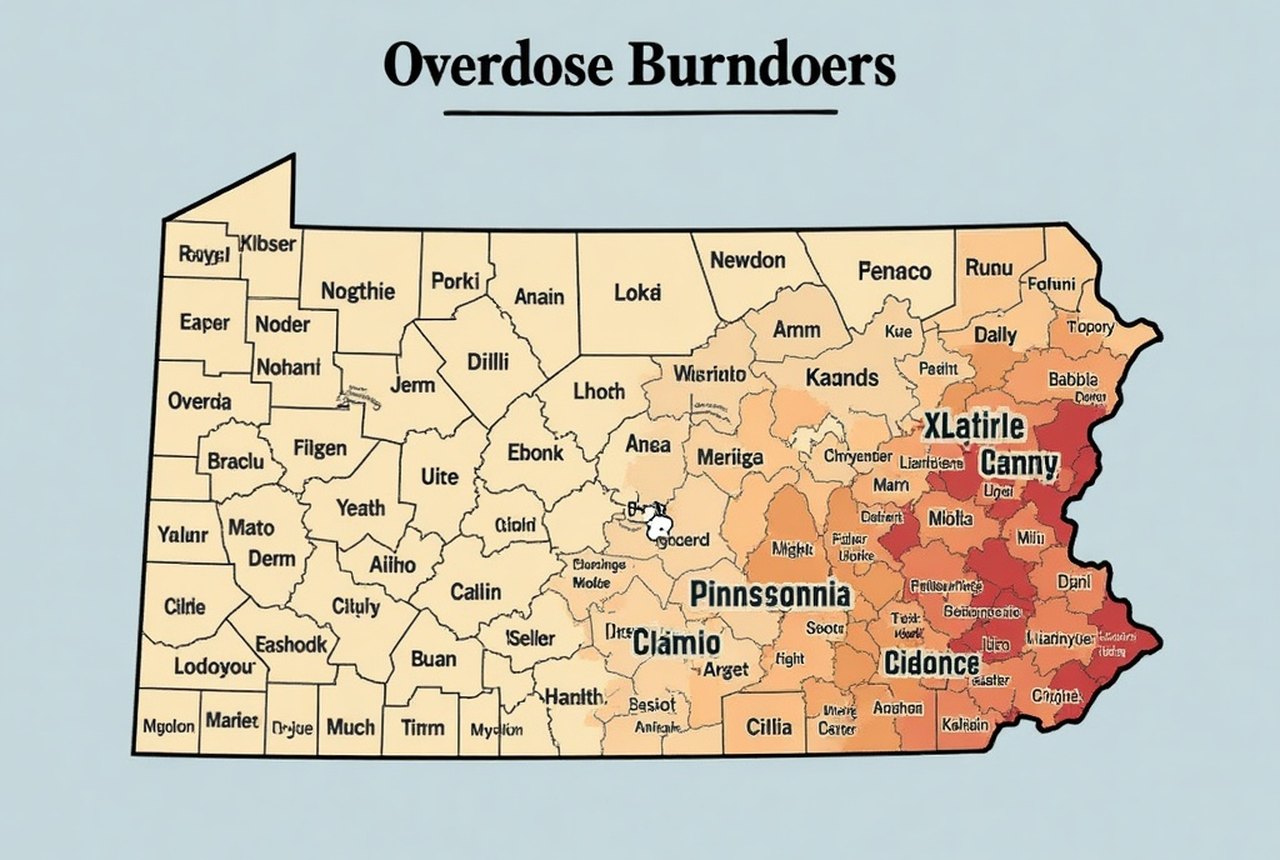
Spending patterns across Pennsylvania's 67 counties reflect a predictable but still troubling unevenness. The counties with the most sophisticated public-health infrastructure — those with larger health departments, established relationships with behavioral health contractors, and prior experience running grant-funded opioid programs — moved fastest to deploy funds. Philadelphia, Allegheny, and several collar counties were already running programs through the Commonwealth's county-based behavioral health managed-care system, giving them both administrative capacity and established provider networks to absorb new funding.
Spending patterns across Pennsylvania's 67 counties reflect a predictable but still troubling unevenness.
Philadelphia's Department of Public Health, which has administered one of the country's more aggressive harm-reduction programs — including a long-running debate over supervised consumption sites — used settlement-linked funds to expand naloxone distribution and bolster its network of low-barrier treatment access points. Penn Presbyterian Medical Center ↗ and other Penn Medicine facilities in West Philadelphia and Northeast Philadelphia serve populations with high rates of opioid use disorder, and community-level settlement spending in those neighborhoods has focused heavily on connecting street outreach to inpatient and outpatient treatment pathways.
The rural picture is considerably harder to read. Centre County, Lewistown and the broader Mifflin County area, and several counties across the state's northern tier received allocations proportional to their population and documented overdose burden — but proportional does not necessarily mean adequate. Lewistown Hospital, the sole inpatient facility for a wide swath of central Pennsylvania, has grappled for years with the primary-care shortage and the behavioral health staffing gaps endemic to rural Pennsylvania. Settlement dollars flowing to Mifflin County are substantial relative to local budgets, yet the region lacks the provider infrastructure to spend them quickly on treatment slots that don't yet exist. Commissioners in several rural counties have spoken publicly about the bind: the money is there but the workforce is not.
Bucks County, which sits at the northern edge of the Philadelphia media market and has suffered some of the highest per-capita overdose death rates in the southeastern corner of the state, has channeled funds into both recovery-housing capacity and a county-run warm-handoff program5 connecting emergency-department visits to peer recovery specialists. Lancaster County and Allentown's surrounding Lehigh Valley region have similarly moved funds toward peer-support models and recovery community organizations, sectors that opioid-program administrators broadly regard as high-value, low-cost interventions.
Southwestern Pennsylvania counties — some of which pursued independent litigation — have in several cases deployed funds through their drug and alcohol single county authorities, the state-designated agencies that have historically managed behavioral health funding at the county level. Those agencies, familiar with state compliance requirements and contract management, have become the de facto administrative vehicle for settlement spending in much of rural and mid-sized Pennsylvania, even where local commissioners technically hold the reins.
- 2021–2022National distributor and J&J settlements finalized; Pennsylvania joins.
- 2022–2023Pennsylvania Opioid Trust established; first disbursements begin.
- 2030sFinal installment payments projected under multi-year settlement structures.
Accountability, Gaps, and What Comes Next
The transparency question is where Pennsylvania's settlement structure faces its sharpest scrutiny. The trust publishes annual reports, and counties are required to report their expenditures, but the granularity of public disclosure varies. Some counties post detailed breakdowns online; others file with the trust with minimal narrative. The result, as health-policy researchers and journalists have noted, is that a complete county-by-county accounting requires aggregating data from the trust, individual county websites, county drug and alcohol authorities, and in some cases public-records requests. There is no single searchable public dashboard that allows a resident or reporter to look up what Dauphin or Luzerne or Erie County spent last year, on what, and with what documented outcome.
That opacity has drawn criticism from harm-reduction advocates who argue that the counties most resistant to evidence-based interventions — needle exchange, medication-assisted treatment with buprenorphine or methadone — are also the least forthcoming about how they're deploying funds. Pennsylvania's overdose death toll, which has tracked above the national average for years according to CDC data, is not simply a function of the amount of money available. It is partly a function of whether that money flows toward interventions the evidence supports, including ones that remain politically contentious in many county seats.
The opioid crisis has also exposed a structural tension that settlement money alone cannot fix. The Commonwealth's county-based behavioral health system, administered through the Department of Human Services ↗, was under-resourced before the settlements and remains so in many regions. New dollars can expand slots, hire peers, and stock naloxone. They cannot, by themselves, rebuild a workforce pipeline that has been leaking licensed counselors and addiction medicine physicians to better-paying positions for a decade. AARP Pennsylvania and the Pennsylvania State Grange, representing older rural residents who have been among the populations most affected by opioid diversion and prescription misuse, have both weighed in on the need for treatment access in areas where the nearest methadone clinic may be an hour's drive away.
There is also the question of duration. The largest settlement payments are structured in installments over many years — in some cases extending into the 2030s. Counties that have built programs on settlement-year-one funding are already confronting what happens when a cohort of recovery housing beds or peer-specialist salaries depends on a revenue stream that is intentionally front-loaded. State officials have pointed to the trust's multi-year disbursement schedule as a feature, not a bug, arguing it prevents a spend-down rush. Advocates counter that the front-end need is acute and that rationing funds over time, when overdose deaths are happening now, involves its own moral calculus.
Harrisburg's role going forward is partly legislative. Several proposals have moved through the General Assembly or been discussed in committee that would increase reporting requirements, create a public-facing expenditure portal, or direct a portion of trust funds toward specific state-level priorities — workforce development, rural infrastructure, youth prevention. Whether any of those measures advances in a politically divided Capitol depends on factors well beyond the settlement framework itself.
What the ledger does show, even imperfectly, is that Pennsylvania has more resources to address its opioid crisis than it did five years ago — and that the distribution of those resources, and the capacity to use them well, is not uniform. The counties with the highest need are not always the ones best positioned to convert a check into a recovery bed, a counseling session, or a life saved. Tracking that gap — insisting that the numbers be public, coherent, and connected to outcomes — is work that belongs to government, advocates, and independent journalism in equal measure.
Who appears in this story
Notes on this story
- Opioid Misuse and Addiction Abatement Trust. Pennsylvania court-created body overseeing settlement fund disbursement.
- Medication-assisted treatment. Use of FDA-approved medications to treat opioid use disorder.
- Harm reduction. Strategies minimizing drug-use risks without requiring abstinence.
- Peer recovery specialist. Person in recovery trained to support others through addiction treatment.
- Warm-handoff program. Direct in-person referral connecting ER patients to recovery support.
- Exhibit E. Settlement document defining approved opioid-fund spending categories.